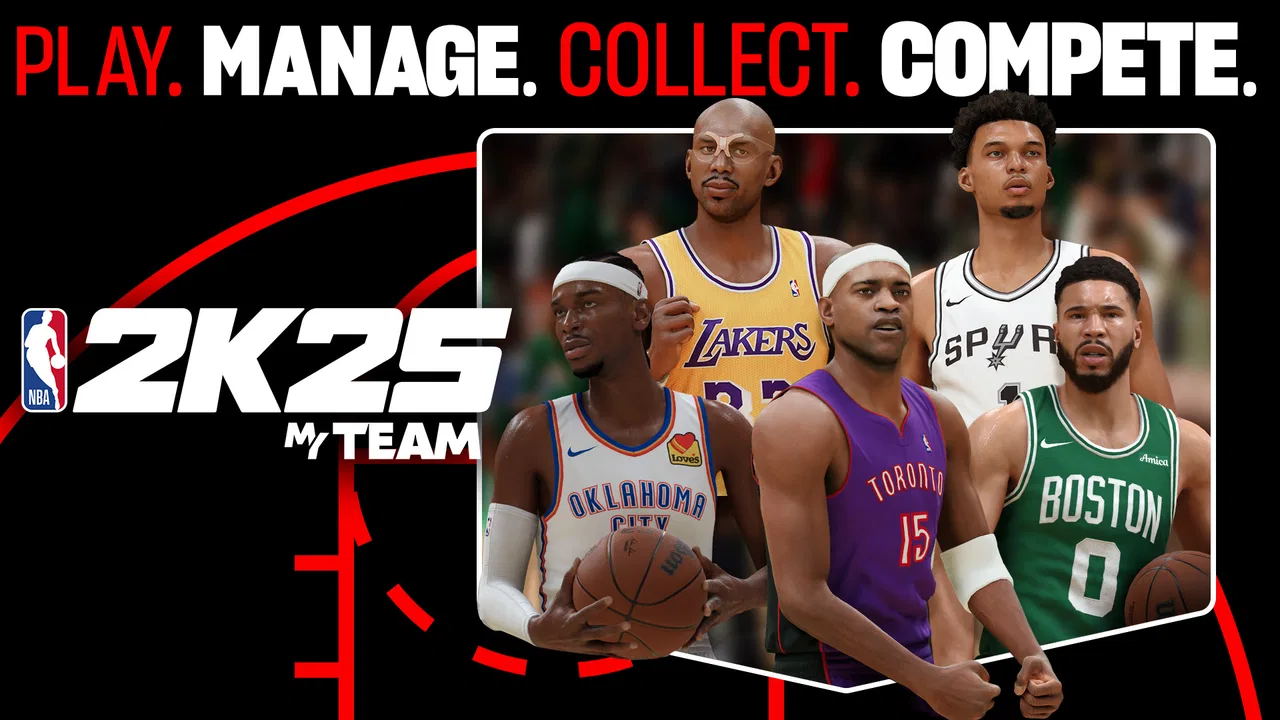
NBA 2K25 MyTEAM
- 4.3
- Rating
- 1.00M
- Installs
- Free
- Price

 Analysis by App-foxy
NBA 2K25 MyTEAM is the kind of mobile sports game I reach for when I want to make progress in short sessions without leaving my console team behind. I tested it as a companion to the wider NBA 2K experience, and its strongest idea is straightforward: my MyTEAM progress can follow me between console and mobile, so a spare moment becomes useful instead of feeling disconnected from the main game. That makes it more focused than a typical basketball game built entirely around quick matches.
It is a free sports game from 2K, Inc., a Take-Two Interactive affiliate, with an Everyone content rating. The mobile release arrived on November 29, 2024, and the current version is 307.02.488110200. It requires Android 9 or later, while the mobile edition is also aimed at players who want access to their team away from the television. The practical question is not whether it contains basketball action; it is whether the shared MyTEAM routine fits the way you already play.
How I built a reliable MyTEAM routine on mobile
I keep my mobile sessions dependable by deciding on one purpose before I open MyTEAM: check the lineup, work toward a particular objective, or play one focused match. That small choice helps me avoid drifting through menus and makes it easier to stop when my available time runs out. Next, I look at how to keep those short sessions useful without turning them into a chore.
You May Also Like

 Google Keep - Notes and lists
Google Keep’s Quiet Growth Shows the Appeal of Simpler Notes
As mobile work gets busier, Google Keep keeps winning a simple contest: capture a thought quickly, find it later, and get on with the day.

 Blood Strike: 2.5 Anniversary
Blood Strike’s Loadouts Turn Every Drop Into a Tactical Gamble
A close look at Blood Strike’s custom loadouts: how fast access to signature weapons reshapes its battle royale rhythm, rewards preparation, and narrows the gap between fights.

 Pandora - Music & Podcasts
Pandora’s Music Is Easy to Start, but Harder to Recover
Pandora’s strength is its low-effort path from a seed to a station. Its weak spot is how much confidence it asks you to place in connection, setup, and quiet recovery.

 8 Ball Pool
 Is Built on Rivalries, Rematches, and Routine
A close look at the rivalries, rematches, shared routines, and unanswered safety questions that turn a quick pool match into a persistent mobile community.

 Samsung Music
’s Quiet Strength Is Playing What You Already Own
Its reach comes less from spectacle than from dependable access to a personal library. That simplicity is both the app’s strongest retention engine and its ceiling.

 AccuWeather: Weather Radar
AccuWeather Review: A Quick, Clear Forecast for Everyday Decisions
For everyday plans, the best forecast is the one you can understand quickly. AccuWeather makes rain timing, radar, and local conditions easy to act on, with a few trade-offs.
More From Our News Desk



A useful companion rather than a replacement for every session
My first recommendation is to decide what you want the mobile version to do before opening it. If I have a long, uninterrupted block of time and want the fullest console-style experience, the console remains the more comfortable choice. The phone is better for checking the team, handling small management tasks, playing a few focused moments, and keeping progress moving when I am away from the main setup.
That distinction matters because MyTEAM can become cluttered if every session starts with random browsing. I get more from the game when I begin with one clear purpose: improve the lineup, complete a current objective, use a reward, or play a particular mode. A simple habit is to check the active objective or reward path first, then choose an activity that supports it. This prevents me from spending energy on matches that do not help the team I am trying to build.
The shared-progress concept is especially convenient in an everyday situation. I might finish a console session at home, then use my phone during a commute break or while waiting for an appointment. Instead of beginning a separate mobile career, I can continue working with the same MyTEAM progress. That continuity is the main reason I would recommend this edition to an existing NBA 2K player.
New players should approach it differently. The amount of team-building information can feel demanding if you do not already understand the basic NBA 2K vocabulary. Cards, lineups, rewards, contracts or consumable decisions, and game objectives can compete for attention. I found it easier to learn by changing one part of the team at a time rather than constantly replacing the entire lineup.
The first-session workflow that saves the most confusion
When I start a session, I look at the lineup before jumping into a game. I check whether the players are positioned sensibly, whether the active group matches the kind of match I want to play, and whether I am about to use a valuable item without meaning to. This takes less time than recovering from a poorly prepared match, especially on a small screen where menus can encourage quick taps.
Next, I choose a single target. It may be a gameplay objective, a reward-related task, or simply a short test of a new player. I avoid combining too many goals in one match because that often produces an awkward lineup and a less enjoyable game. A focused target also gives me a clear stopping point, which is useful when playing on a phone rather than settling in for a full evening.
After the match, I review the result immediately. I look at what changed, collect anything that is ready, and decide whether the next action is genuinely worthwhile. This post-match check is one of the most useful habits I developed. Without it, it is easy to keep playing automatically while missing a reward, leaving a lineup adjustment unfinished, or using a roster that no longer suits the next task.
My best general rule is to treat each mobile session as a small work order, not an endless basketball marathon. That approach makes the game feel more controlled and reduces the temptation to chase every available activity at once.
Settings and controls worth checking before serious play
Mobile basketball feels different from playing with a physical controller, so I recommend spending time with the control options before judging the game. I check whether the selected layout lets me see the court clearly, whether buttons are comfortable for my grip, and whether defensive actions are easy to reach without covering the action. A layout that feels fine while standing can feel awkward when holding the phone with both hands for a longer session.
I also pay attention to camera choice. A view that looks impressive is not automatically the most useful one. For MyTEAM objectives, I prefer a camera angle that helps me read spacing, identify open players, and follow defensive assignments. If I am struggling to understand why a play fails, changing the camera can be more useful than immediately changing the lineup.
Audio is another small but practical consideration. I lower it when playing in public and make sure visual feedback is clear enough that I do not depend on commentary or sound effects. On a phone, readable prompts and a comfortable interface matter more than presentation flourishes. I would rather have a clean view of the court than a crowded display that makes defensive decisions late.
Before a serious run, I test the controls in a low-pressure situation. This is where I learn how much force or timing a particular action needs on my device. Touch controls can feel inconsistent when my thumb is placed slightly differently, and a familiar console habit does not always transfer perfectly. I do not try to master every command immediately; I choose the few actions that support my current lineup and objectives.
Small shortcuts that make repeat sessions faster
The fastest players I know do not necessarily tap more quickly. They make fewer unnecessary decisions. I keep a preferred lineup ready for ordinary matches and make a separate adjustment only when an objective demands it. That prevents me from rebuilding the team from scratch every time I open the game.
I also group my decisions. Instead of changing one player, starting a match, returning to the menu, and changing another player later, I handle lineup changes together. The same applies to reviewing rewards and checking items. Batching these actions makes the mobile interface feel considerably less tiring.
Another useful pattern is to test new cards in a controlled way. I do not replace half the roster and then try to understand why the team feels different. I introduce one meaningful change, play enough to notice its effect, and then decide whether it deserves a permanent place. This is particularly helpful for players who enjoy collecting but still want a lineup that behaves consistently.
For short sessions, I choose tasks with a predictable finish. A quick objective or a single match is easier to fit into daily life than an open-ended plan to improve everything. If I only have a few minutes, I may manage the lineup or review progress instead of starting a game that I will have to abandon. This is not glamorous, but it protects the quality of the experience.
Players moving from console should also resist the urge to copy every control habit exactly. The mobile version rewards adaptation. I use simpler, more deliberate actions and concentrate on positioning rather than attempting advanced combinations whenever the screen feels crowded. The goal is not to prove that the phone can imitate a controller perfectly; it is to make each possession readable and repeatable.
Where the mobile format becomes genuinely convenient
The shared MyTEAM progress gives this game a specific advantage over basketball titles that keep mobile and console experiences separate. I can use the phone for maintenance and then return to the larger screen without feeling that the mobile session was isolated. That is valuable for players who already invest time in MyTEAM and want more flexibility around their schedule.
It is also useful for people who enjoy team management as much as direct gameplay. A mobile session can be worthwhile even when I am not in the mood for a long competitive run. I can inspect the roster, think about the next adjustment, and prepare for the next console session. The game therefore works best as part of a broader routine rather than as a completely independent basketball product.
For a newcomer, however, I would not describe it as the simplest way to learn basketball games. The connection to the larger MyTEAM ecosystem is a strength for experienced users, but it can make the first steps feel busy. Someone who only wants a quick, uncomplicated basketball match may prefer a more focused mobile title with fewer roster decisions and less emphasis on long-term team building.
What to understand about purchases and long-term commitment
The game is free to download, but in-app purchases range from $1.99 to $149.99 per item. That range is important when deciding how to play. I recommend treating purchases as optional rather than as part of the basic installation decision. The most comfortable approach for me is to begin with the free experience, learn the menus, and understand what kind of progress I actually enjoy before considering any spending.
MyTEAM naturally encourages attention toward better cards and faster improvement, so players who are sensitive to collection pressure should set a personal boundary early. I avoid buying something simply because I had a poor match or because a new item looks exciting in the moment. Waiting gives me a clearer idea of whether it solves a real lineup problem or merely creates another short-term target.
Parents should also remember that an Everyone rating describes the content rating, not a promise that every family will want optional purchases enabled. I would review device-level purchase controls before handing the game to a child. The same advice applies to adults who want to keep spending separate from casual play: decide the limit before entering the store, not after an impulsive session.
Limits I noticed after settling into the routine
The biggest limitation is that mobile convenience does not remove the compromises of a small screen. Defensive positioning, timing, and precise control can feel less natural than they do with a console controller. When I am tired or playing in a cramped position, mistakes become more common. The game is much more enjoyable when I use it for focused sessions rather than expecting the phone to replace the full console setup in every situation.
The interface can also demand patience. MyTEAM has several layers of decisions, and moving between lineup management, rewards, and matches can make a quick task feel longer than expected. The solution is not to explore every menu every time. I use a repeatable route and leave deeper roster experiments for a session when I actually have the attention for them.
Another trade-off is that shared progress makes the mobile version more useful to established players than to people starting from nothing. If I already care about my MyTEAM roster, the connection is meaningful. If I do not, the central appeal is weaker, and a standalone mobile basketball game may provide a cleaner first experience.
I would also skip it if my main priority is a purely offline, low-maintenance game. NBA 2K25 MyTEAM is built around ongoing team progress and regular engagement. That structure suits players who enjoy returning to their roster, but it may feel like unnecessary responsibility to someone who wants to play a match and close the app without thinking about collection choices afterward.
How it compares with the usual mobile basketball alternatives
Compared with a simple arcade basketball game, this title asks for more planning and offers a more connected team-building routine. The reward is a stronger sense of continuity for players already invested in MyTEAM. The cost is a steeper learning curve and more menu time. I would choose the arcade alternative for a quick, uncomplicated burst of play, but I would choose this one when my roster and long-term progress matter.
Compared with a separate mobile basketball simulator, the key distinction is the relationship with console progress. A standalone simulator may feel more self-contained and easier to understand from the first launch. NBA 2K25 MyTEAM makes more sense when I want one team-building journey across devices. That makes the decision less about which game has the most basketball content and more about whether shared continuity is valuable to me.
It also differs from a traditional console-only sports routine. The phone lets me turn small gaps in the day into useful preparation, but it does not offer the same physical control comfort. I see the mobile edition as a second doorway into MyTEAM, not a universal replacement for the console. That distinction keeps expectations realistic and makes its strengths easier to appreciate.
Who should install it, and who should pass
I would recommend it to an NBA 2K player who already enjoys MyTEAM, wants access away from the console, and is comfortable learning a touch-based control scheme. It is particularly appealing to people who like making measured roster changes, completing focused objectives, and using short sessions to support a larger team-building plan.
I would be more cautious recommending it to someone who wants instant, uncomplicated basketball. The menus, collection focus, and optional purchase range can feel like distractions if the only goal is a quick match. I would also suggest skipping it if you dislike long-term progression systems or know that frequent reward prompts make games stressful rather than enjoyable.
For families, the Everyone rating makes the content broadly accessible, but I would still supervise purchase settings and explain that free access and optional spending are separate decisions. For competitive players, I would start with control adjustments and a stable lineup before chasing difficult objectives. For casual players, I would use it in short, defined sessions and avoid turning every available task into a requirement.
My verdict after making the habits repeatable
NBA 2K25 MyTEAM works best when I use it deliberately. The winning routine is simple: prepare the lineup, check the target, adjust the controls to the device, play one focused activity, and review the result before closing the game. Those habits make the mobile version feel like a useful extension of MyTEAM rather than a crowded collection of disconnected menus.
Its public reception is strong, with a 4.4 average from around 70 thousand ratings, and the game has passed a million installs. Those figures fit my overall impression: there is a clear audience for a mobile companion that keeps a MyTEAM journey moving. They do not change the central trade-off, though. The experience is most convincing for existing NBA 2K players, while newcomers may need more patience before the structure feels natural.
I like the flexibility, the ability to continue working with my team away from the console, and the way short sessions can have a clear purpose. I dislike the touch-control compromises, the busy progression structure, and the pressure that optional purchases can create for players who are not careful with boundaries. The game is free, but the best experience comes from knowing what I want from it before I start.
My final recommendation is therefore specific: install it if shared MyTEAM progress is the feature you have been waiting for and you are willing to adapt your play style to mobile. Use it as a focused companion, not as a demand to play constantly. If you want a simpler basketball game with fewer management decisions, another mobile option will probably suit you better. For the right player, however, NBA 2K25 MyTEAM is a practical way to keep a serious team-building routine alive between console sessions.
FAQs for NBA 2K25 MyTEAM
01What are the main features of NBA 2K25 MyTEAM?
NBA 2K25 MyTEAM offers a robust card-collecting mode where players can build their dream team. It features new card tiers, enhanced customization options, and updated player dynamics. Users can participate in seasonal challenges and events, providing a dynamic and engaging experience throughout the year.
02Is NBA 2K25 MyTEAM accessible for beginners?
Yes, NBA 2K25 MyTEAM includes a tutorial mode designed to guide newcomers through the basics of gameplay, card management, and strategy. It also offers difficulty levels that can be adjusted to match the player's skill level, ensuring an enjoyable experience for both beginners and seasoned players.
03How does the in-game currency system work in NBA 2K25 MyTEAM?
NBA 2K25 MyTEAM uses two main types of in-game currency: Virtual Currency (VC) and MyTEAM Points (MTP). VC is used for various game modes, while MTP is specific to MyTEAM. Players earn MTP through gameplay or by completing challenges, allowing them to purchase new player cards and packs.
04Are there any microtransactions in NBA 2K25 MyTEAM?
Yes, NBA 2K25 MyTEAM includes microtransactions as an optional feature. Players can purchase Virtual Currency (VC) to accelerate their progress by buying packs or upgrading their team. However, all content is accessible through gameplay, providing a fair balance for those who prefer not to spend extra money.
05What platforms is NBA 2K25 MyTEAM available on?
NBA 2K25 MyTEAM is available on multiple platforms, including PlayStation, Xbox, Nintendo Switch, and PC. Each platform offers a similar gaming experience with cross-platform features allowing players to compete against friends regardless of their chosen device, enhancing the game's accessibility and community engagement.
Pros
- Stunning graphics enhance gameplay immersion.
- Wide variety of player cards to collect.
- Engaging multiplayer modes with friends.
- Regular updates with new challenges.
- Customizable team strategies and playstyles.
Cons
- Requires constant internet connection.
- In-app purchases can be pricey.
- Occasional server issues disrupt play.
- High device storage requirement.
- Learning curve for new players.

NBA 2K25 MyTEAM
Gallery